A Complete Guide to Importing from India to the UK

In an increasingly globalised economy, importing goods from India to the United Kingdom offers entrepreneurs and established businesses alike exciting opportunities. India’s rich manufacturing base, cost-competitive production, and diverse product range—from textiles and handcrafted goods to industrial components—make it a strategic sourcing destination. With evolving trade policies, including recent free trade developments, understanding how to import successfully has never been more relevant.

🌍 Why Import from India?

India’s manufacturing landscape spans across sectors, including Carpets, Jwellery, textiles, leather goods, handicrafts, pharmaceuticals, auto components, and more. Its cost-effective production, robust supplier networks, and high-quality craftsmanship attract importers from around the world. Additionally, the India–UK Free Trade Agreement (FTA), aimed at reducing tariffs on the majority of products, is poised to make trade between the two nations even more attractive and competitive. Under the agreement, up to 99% of Indian exports could enter the UK duty-free, significantly improving margins for UK importers once fully in effect.

🧭 Key Steps in the UK Import Process

Importing from India to the UK involves a series of crucial steps, from initial planning to delivery and customs clearance. Below is a breakdown of the essential stages.

1. Get Your Business Ready

Before importing, establish your business credentials:

  • EORI Number: You must have an Economic Operators Registration and Identification (EORI) number that starts with “GB” to import into Great Britain. This number is essential for customs declarations.
  • VAT Registration: If you intend to sell goods in the UK, VAT registration will be necessary, and you’ll need to understand how import VAT works.

2. Choose Your Products and Suppliers

India’s supplier ecosystem is vast, but finding reliable partners is critical:

  • Supplier Vetting: Use verified listings, attend trade fairs, or hire sourcing agents to find trustworthy manufacturers.
  • Sample and Quality Checks: Always request samples and conduct quality inspections before placing bulk orders.

3. Understand Duties and Taxes

Once your shipment arrives in the UK, it must clear customs. The main financial considerations include:

  • Import Duty: Depending on the product category, customs duty may apply. However, due to the India–UK FTA, many goods imported from India may qualify for zero duty once the agreement is fully operational.
  • Import VAT: Most imports into the UK are subject to import VAT (usually 20%), calculated on the total value of the goods plus duty and shipping. 

To calculate duties and taxes accurately, you’ll need the Harmonized System (HS) code for your products—this is used by customs to classify goods.

4. Documents You’ll Need

Accurate documentation is essential for clearing goods through customs:

  • Commercial Invoice: Details the price, terms, and description of the goods.
  • Packing List: Lists the contents and packaging details.
  • Bill of Lading or Airway Bill: Evidence of the contract of carriage.
  • Certificate of Origin: This may be required to qualify for preferential tariff treatment under the FTA.
  • Other Certificates: Depending on the product (e.g., health certificates for food items).

5. Shipping Options

You can ship goods from India to the UK via:

  • Air Freight: Faster (typically 3–7 days) but more expensive.
  • Sea Freight: Slower (4–6 weeks) but cost-effective for larger shipments.
  • Courier Services: Useful for small parcels with quicker delivery.

Choosing between Full Container Load (FCL) and Less than Container Load (LCL) depends on your shipment size and budget.

6. Customs Clearance and Logistics

Once your goods reach the UK port or airport:

  1. Customs Declaration: Submit a customs entry to UK HM Revenue & Customs (HMRC) via the Customs Declaration Service.
  2. Pay VAT and Duty: HMRC will assess and notify you or your agent when fees are due.
  3. Inspection: Goods may be inspected if required.
  4. Delivery: After clearance, the shipment is forwarded to your warehouse or distribution centre.

Most importers work with customs brokers or freight forwarders to manage these steps efficiently.

🚧 Common Challenges When Importing

Importing is rewarding, but there are challenges worth preparing for:

  • Regulatory Compliance: Products must meet UK safety, labeling, and packaging standards.
  • Documentation Errors: Mistakes in paperwork can lead to delays or penalties.
  • Supplier Reliability: Without proper vetting, quality inconsistencies and delivery delays can significantly impact your business.

📈 Take Advantage of the India–UK Trade Agreement

The India–UK FTA currently being implemented is designed to foster trade by reducing or eliminating tariffs on a wide range of products. This means:

  • Indian exporters of textiles, leather, gems and jewelry, and other manufacturing goods may enter the UK with little to no customs duty.
  • UK importers can potentially improve profit margins by lowering acquisition costs.

However, proper certification of origin and compliance with rules of origin are necessary to benefit from preferential tariffs.

🤝 How ImportCare Can Help

Importing from India can be complex, especially if you’re new to international trade. That’s where ImportCare steps in as your trusted sourcing and import partner.

ImportCare operates as your personal import representative based in India, helping international buyers navigate the entire sourcing and import process. They specialise in:

  • Finding reliable, verified suppliers across multiple industries.
  • Negotiating pricing and terms to ensure competitive deals.
  • Organising quality inspections and pre-shipment checks so products meet your standards.
  • Coordinating logistics and export documentation for smooth shipping.

ImportCare offers flexible engagement models—whether you need support for occasional shipments or long-term sourcing partnerships—and even provides free initial consultations to help you assess product availability and pricing.
Goods That Do Not Require an Import Licence in the UK

Most items brought into the UK do not need any kind of import licence. The UK operates a liberal import regime, meaning a licence is only required for restricted or controlled goods.

Below are the broad categories and examples of goods that freely enter the UK without an import licence (although normal customs rules, duty/VAT and documentation still apply):

1. General Consumer Goods (No Licence Required)

These everyday items are not licence-controlled:

  • Clothing and apparel
  • Footwear
  • Fashion accessories (bags, belts, wallets, scarves)
  • Jewellery (non-precious or standard precious metal jewellery)
  • Cosmetics and skincare (non-medical, non-prescription)
  • Toys and games (not including weapons imitation)
  • Home décor products
  • Craft items and handicrafts
  • Household items (cleaning products, homeware)
  • Kitchenware and utensils
  • Small electronics (speakers, headphones, accessories) — unless they contain restricted batteries
  • Phone accessories and chargers
  • Furniture and home goods
  • Stationery items
  • Books, diaries, printed materials

2. Most Machinery & Industrial Goods

Unless it includes military use, dual-use tech, chemicals, or radioactive elements, machinery is licence-free.

Examples:

  • Textile machinery
  • Construction tools
  • Industrial equipment
  • Food processing machinery
  • Agricultural machines (not containing restricted chemicals)
  • Packaging machinery
  • Printing machines and spare parts

3. Most Food & Beverages (with Exceptions)

Although some foods need health certificates, an import licence is generally not required.

Licence-free examples:

  • Packaged dry food (snacks, biscuits, cereals, tea, coffee)
  • Beverages (non-alcoholic)
  • Spices and condiments
  • Confectionery and chocolates
  • Canned foods
  • Pasta, rice, grains
  • Edible oil (vegetable/olive oil)

Note:
Meat, dairy, eggs, and certain high-risk plant goods may require health certificates, but still do not need an import licence, only compliance checks.

4. Automotive Goods (Most Items)

Licence-free:

  • Car parts
  • Motorbike parts
  • Tyres (unless special environmental controls apply)
  • Car accessories
  • Tools and diagnostic devices

Note: Cars themselves do not need an import licence but must follow UK vehicle approval rules.

5. Electronics & Tech Items (Majority Are Free)

Most tech imports do not require licences:

  • Laptops, mobile phones, tablets
  • LED lights and bulbs
  • CCTV cameras (non-military grade)
  • Smart home gadgets
  • Power banks (if battery certifications are proper)
  • Computer accessories & components

Exceptions:
Dual-use items used for military/cybersecurity purposes may require a licence.

6. Packaging & Printing Items

These items are also licence-free:

  • Custom boxes & packaging materials
  • Paper bags, pouches, wrappers
  • Labels and stickers
  • Printing materials (ink, plates, rolls)
  • Corrugated cartons
  • Bubble wrap, shrink wrap

7. Personal Care & Beauty Accessories

No import licence is needed for:

  • Hair accessories
  • Grooming tools
  • Makeup tools and brushes
  • Fragrances (non-chemical restricted)
  • Manicure/pedicure accessories

8. Non-Medicine Health Products

Not requiring any import licence:

  • Fitness equipment
  • Supplements (non-medicinal)
  • Herbal items (non-restricted plants)
  • Wellness products
  • Healthcare devices like massagers

Note: Medicines, prescription products, and some medical devices do require approval — but not necessarily a licence.

Important Note

Even though these goods do not require an import licence, you must still:

  • Follow product safety rules
  • Provide correct customs documentation
  • Ensure UKCA/CE compliance
  • Pay duty & VAT
  • Meet labelling standards

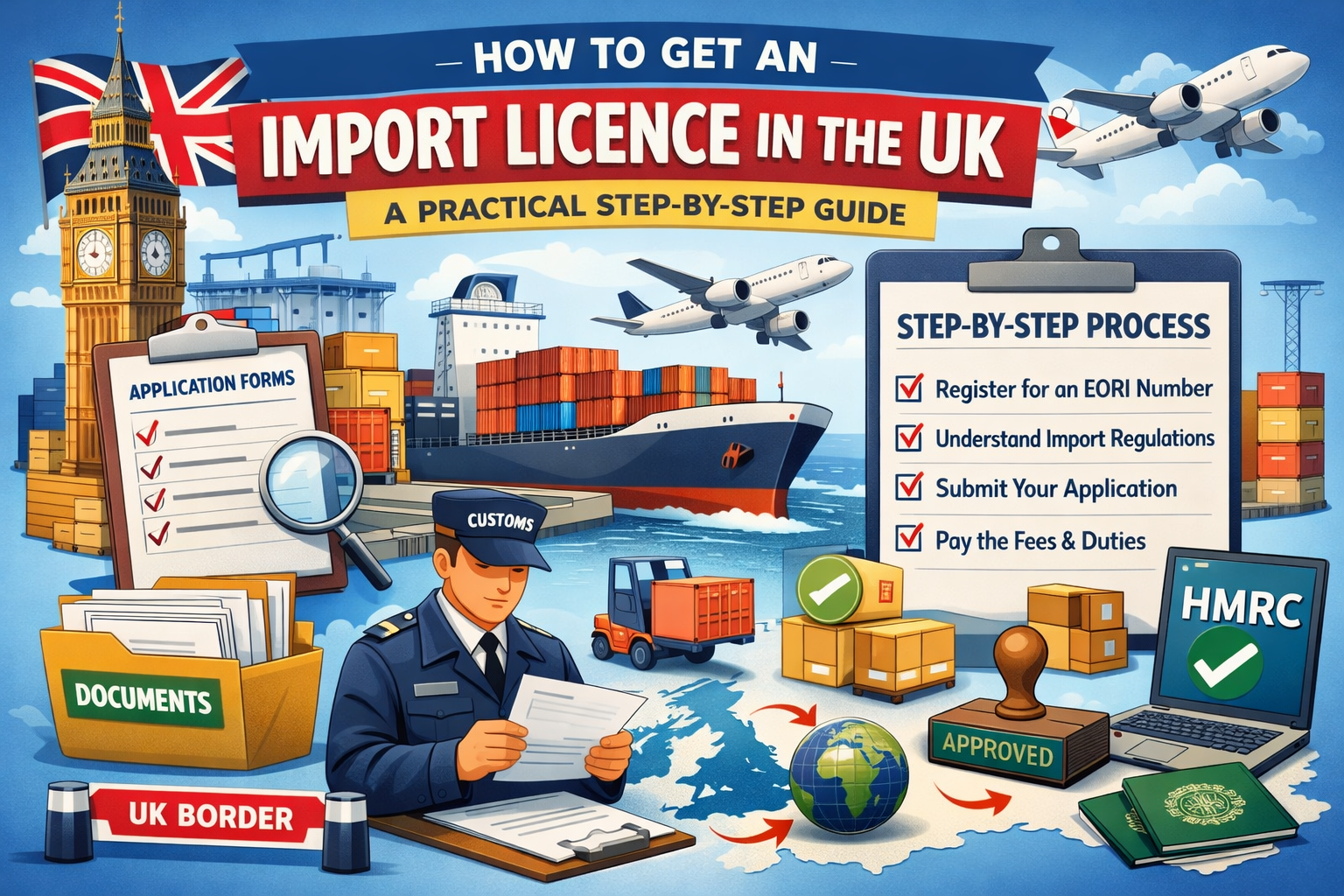
How to get an import licence in the UK — a practical step-by-step guide

Importing into the UK is generally straightforward, and most products do not require an import licence. However, certain controlled, sensitive, or restricted goods do fall under licensing rules. This guide explains how to check whether you need a licence, who issues it, and how to apply—plus practical tips to avoid delays.

👉 If you want to know which goods do not require an import licence, read this detailed guide here: Goods That Do Not Require an Import Licence in the UK


1. Do You Actually Need an Import Licence?

Many importers assume they need a licence, but in reality:

  • 90%+ of goods do not require a licence.
  • Licences apply only to specific restricted items.

You may need an import licence if you’re importing:

  • Military or dual-use items
  • Controlled chemicals
  • Firearms and ammunition
  • Plants, seeds, or animals
  • Certain medicines
  • Items under sanctions or quota controls
  • Radioactive or hazardous materials

Before importing, always check GOV.UK for the exact classification and any restrictions.

2) Identify the correct licensing authority

Different types of products are handled by different departments/authorities:

  • Department for Business & Trade — Import Licensing Branch (ILB): issues many formal import licences, including for goods controlled under UK or international commitments (sanctions, quota-managed agricultural goods, etc.). Applications are made through the government’s import licence service / ICMS.
  • HM Revenue & Customs (HMRC): handles customs declarations, tariff classification and revenue procedures (not import licences per se, but you’ll deal with HMRC for duty/VAT and commodity codes).
  • Other specialist bodies: e.g., Department for Environment, Food & Rural Affairs (DEFRA) or the Animal and Plant Health Agency (APHA) for plants/animals/agricultural produce; the Medicines and Healthcare products Regulatory Agency (MHRA) for medicines and some medical devices; Police or Home Office for firearms; and licensing under chemical controls / PIC for some chemicals. Check the product-specific guidance page to find the right authority.

3) Prepare the documents and information you’ll need

Before you start an application, gather the usual supporting details:

  • Full business name, address, company registration/UEI and contact details.
  • EORI number starting with GB (Economic Operators Registration and Identification). You need an EORI to move goods and to use customs services (you can get one online — you’ll usually receive it immediately or within 5 working days).
  • Commodity (HS/commodity) code for the goods — this determines whether a licence is required and the duty/VAT rate. Use the UK Trade Tariff to look up codes.
  • Commercial invoice, supplier/exporter details, transport documents (AWB/Bill of Lading), packing list, any existing certificates (e.g., phytosanitary, health certificate, CE/UKCA conformity evidence).
  • If applying for a licence linked to sanctions or restricted end-use, you may need detailed end-user and end-use declarations and supporting evidence.

4) Apply — platforms, forms and the Import Case Management System (ICMS)

Most formal import licence applications are made via the government’s online service:

  • Apply for an import licence (GOV.UK portal / ICMS). Use the official “Apply for an import licence” service; it uses GOV.UK One Login / your government sign-in and is the route for ILB applications. Contact details are provided on the service if you need help.

Typical steps in the online application:

  1. Sign in / create a GOV.UK One Login.
  2. Complete the online form for the licence type requested — give commodity code(s), quantities, country of origin/destination, seller/importer details, and upload supporting documents.
  3. Pay any application fees where applicable (some licence types charge a fee).
  4. Submit and note the case/reference number. The department will process the case and may request further information.

Processing time varies by licence type and complexity. For straightforward cases you may receive a licence fairly quickly; controlled or complex cases (sanctions, dual-use, agricultural restrictions) can take longer.

5) What if your goods are controlled by other rules (sanctions, health or safety)?

  • Sanctions / Trade controls: Importing goods subject to UK sanctions without the correct licence is a criminal offence. Sanctions licences are handled via the same online application process but will be assessed against the sanctions regime and may require extra checks.
  • Agricultural, animal or plant products: Many of these need official certificates (phytosanitary, veterinary) issued by the exporter’s competent authority and possibly checks on arrival. DEFRA/APHA guidance tells you which species and products are controlled and what documentation is needed.
  • Medicines/medical devices/chemicals: These often need MHRA approval or chemical-specific permits (PIC) — consult the specific guidance pages listed on GOV.UK.

6) After you get the licence — customs declarations and clearance

Getting the licence is only one step. When your goods arrive you must:

  • Make the appropriate customs declaration (or arrange for your freight forwarder/agent to do so). Use your EORI on the declaration. HMRC processes import declarations and assesses duties/VAT.
  • Present licences and certificates to the relevant authorities if requested at border control. Maintain copies for your records.
  • Pay duty and VAT (or use postponed accounting if you are VAT registered and eligible). Consider using a customs agent or broker if you’re new to importing.

7) If the application is refused or delayed — what to do

  • You’ll receive reasons for refusal or requests for more information. Respond quickly and fully — missing paperwork is the most common cause of delay. If the decision appears incorrect, check review/appeal options listed in the decision letter and on the relevant GOV.UK page for that department. In some cases you can request reconsideration or administrative review.

8) Practical tips & common pitfalls

  • Check early: Find out whether your goods are controlled before signing contracts or shipping. A sale that looks fine on paper can be blocked at the border if a licence is required.
  • Classify correctly: A wrong commodity code can mean you fail to identify a licence requirement — use the UK Trade Tariff and HMRC guidance.
  • Get an EORI early: You’ll need it for declarations — apply as soon as you start importing.
  • Work with a customs agent or freight forwarder: For complex goods (chemicals, foodstuffs, pharmaceuticals) a specialist can save time and avoid fines.
  • Keep records: Retain import licences, declarations, invoices and certificates for the period required by HMRC and other regulators.

9) Where to find official help and up-to-date lists

  • GOV.UK — Import goods into the UK (overall import process and EORI info).
  • GOV.UK — Apply for an import licence (government online service / ICMS).
  • GOV.UK — Import controls and lists of controlled goods (to check whether your commodity appears). Note that these pages are updated — always check the “last updated” date on a GOV.UK page.
  • GOV.UK guidance PDF on Standards and regulatory import requirements (detailed guidance for particular product types and conformity).

Quick checklist — before you import

  1. Confirm whether the goods need an import licence.
  2. Get your GB EORI number.
  3. Identify the correct commodity (HS) code and licensing authority.
  4. Gather commercial invoice, transport docs, certificates and end-user declarations.
  5. Apply online via the GOV.UK import licence service if required.
  6. Make customs declaration on arrival and keep records.

Final notes

Import licensing rules can change (sanctions lists, disease outbreaks, new controls), so always check the relevant GOV.UK pages for the product you’re importing and note the page’s last-updated date before you act. If your case is complex (sanctions, dual-use military items, or goods with tight quotas), consider getting professional advice from a customs broker, trade consultant or legal adviser experienced in the specific product sector.

How to Start an Import-Export Business in the UK: A Complete Step-by-Step Guide

Starting an import-export business in the UK is exciting: it opens you to global customers, supply options, and margin opportunities. But cross-border trade also brings rules, paperwork, and logistical complexity. This guide walks you through the practical, chronological steps — from idea to first shipment — with the core tasks you must complete and the common pitfalls to avoid.

1. Decide what you’ll trade and validate the market

Begin with a clear product focus. Niche, non-perishable items or components that solve a specific problem are easier to scale than random consumer goods.

  • Research demand: check competitor listings, marketplaces (e.g., Amazon/eBay), industry reports, and trade forums to identify price points and margins.
  • Consider regulations: food, cosmetics, electronics, chemicals, plant/animal products, and toys often require licenses, testing, or extra certification.
  • Test quickly: order samples, validate supplier reliability, and run a small pilot to confirm product quality and customer willingness to pay.

2. Choose your business structure and register

Pick a legal form (sole trader, partnership, limited company) based on liability, tax, and growth plans. Most importers/exporters choose a limited company for clearer separation of personal assets.

  • Register your company with Companies House.
  • Register for UK VAT if required (compulsory once turnover crosses the threshold; voluntary registration can have advantages for reclaiming import VAT).
  • Open a business bank account suited for international payments (multi-currency features are helpful).

3. Get the right IDs, licenses, and HMRC registrations

Before you trade, there are practical registrations you’ll need:

  • EORI number (Economic Operators Registration and Identification): required for customs declarations when importing or exporting to/from non-UK territories.
  • Check if your goods need specific licences or certificates (e.g., DEFRA for plants/animals, Department for Business licensing for dual-use or controlled products).
  • If you’re importing, understand commodity codes / HS codes for your goods — they determine duties and requirements.

4. Understand customs, duties, and VAT

Customs procedures changed after Brexit; importers/exporters must be prepared:

  • Learn how customs declarations work (or hire a customs broker/freight forwarder). You’ll need accurate HS codes, country of origin, commercial invoice values, and shipping terms.
  • Calculate duties and import VAT to price your products correctly.
  • Consider bonded warehouses or customs postponement schemes to help cash flow on import VAT.

5. Plan logistics and choose partners

Decide on Incoterms (e.g., EXW, FOB, CIF, DDP) — they define who bears shipping, insurance, and customs costs. Choose logistics partners accordingly:

  • Freight forwarder: handles booking, documentation, and customs clearance. They’re invaluable for first-time traders.
  • Carrier options: sea (cheaper but slower), air (fast but expensive), road (for continental Europe). Mix according to product value and lead time.
  • Insurance: ensure cargo is insured (marine cargo insurance) for transit risks.

6. Secure suppliers and negotiate terms

Build supplier relationships with clear contracts:

  • Ask for references, factory photos, certificates, and sample testing.
  • Negotiate MOQs, lead times, payment terms (letter of credit, T/T, PayPal), and penalties for late or defective shipments.
  • Insist on written commercial agreements that state INCOTERMS, delivery schedule, quality standards, and dispute resolution terms.

7. Set up payments and manage foreign exchange risk

International trade involves FX exposure and payment risk:

  • Offer secure payment methods and consider using trade finance like letters of credit for higher-value shipments.
  • Use a payments provider or bank that offers competitive FX and multi-currency accounts.
  • Hedge large, recurring exposures with forward contracts or regular conversion strategies to protect margins.

8. Prepare documentation and compliance processes

Accurate paperwork prevents costly delays:

  • Standard documents: commercial invoice, packing list, bill of lading/airway bill, certificate of origin, insurance certificate, and any product-specific certificates.
  • Keep digital records organized — customs audits and VAT reclaim processes rely on good paperwork.
  • Put compliance checks in place for sanctions, embargoes, anti-money-laundering, and product safety rules relevant to your markets.

9. Price, sell, and manage customers

Develop a pricing model that covers landed cost (product + duties + VAT + shipping + insurance + handling + margin).

  • Determine your sales channels: B2B (wholesale/retail partnerships), direct to consumer (D2C websites, marketplaces), or distributors.
  • Offer clear lead times, return policies, and warranty terms. For B2B buyers, include Incoterms, payment windows, and MOQ details in quotes.
  • Build a repeatable fulfilment plan once orders scale: local fulfilment, third-party logistics (3PL), or drop-shipping options for lower inventory risk.

10. Start small, iterate, and scale

Trade is an iterative business.

  • Begin with a small shipment to test suppliers, customs, logistics, and customer feedback.
  • Track key metrics: landed cost per unit, lead time, order defect rate, return rate, and margin per SKU.
  • Use feedback to renegotiate terms, improve packaging, or switch carriers.

11. Common pitfalls and how to avoid them

  • Inaccurate HS codes → unexpected duties and delays. Double-check with a broker.
  • Underestimating landed costs → squeezed margins. Run full landed-cost models before pricing.
  • Poor supplier checks → quality issues. Always request samples, audits, or third-party inspections.
  • Ignoring regulatory compliance → seized shipments or fines. Verify licenses and labelling rules per market upfront.

Quick launch checklist

  • Business registered, and bank account opened
  • EORI number obtained
  • VAT registration decision made
  • Supplier vetted and sample approved
  • HS codes and customs process defined
  • Freight forwarder and insurer chosen
  • Incoterms agreed, and the commercial invoice template is ready
  • Payment and FX arrangements set up
  • Pilot shipment planned