
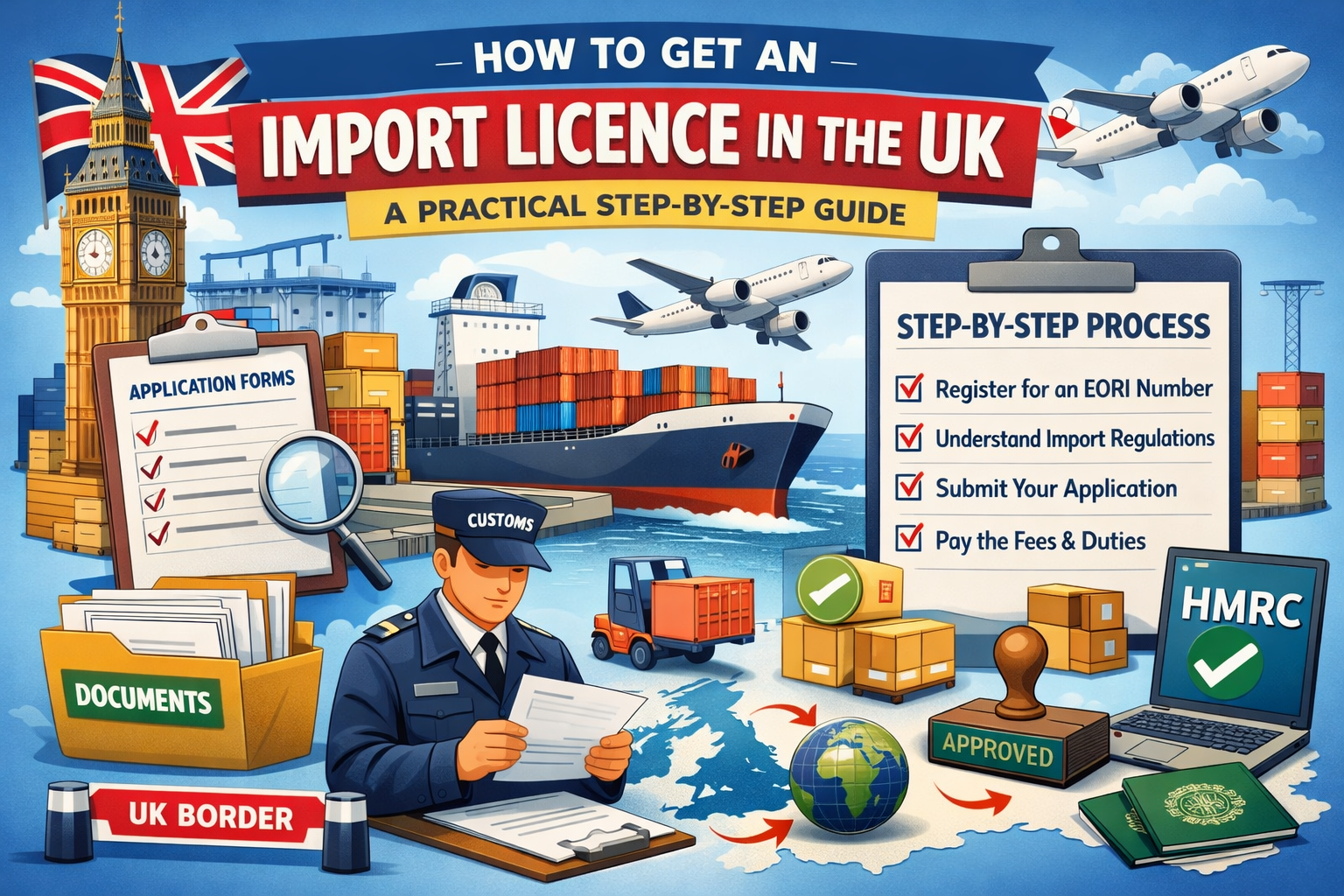
How to get an import licence in the UK — a practical step-by-step guide
Importing into the UK is generally straightforward, and most products do not require an import licence. However, certain controlled, sensitive, or restricted goods do fall under licensing rules. This guide explains how to check whether you need a licence, who issues it, and how to apply—plus practical tips to avoid delays.
👉 If you want to know which goods do not require an import licence, read this detailed guide here: Goods That Do Not Require an Import Licence in the UK
1. Do You Actually Need an Import Licence?
Many importers assume they need a licence, but in reality:
- 90%+ of goods do not require a licence.
- Licences apply only to specific restricted items.
You may need an import licence if you’re importing:
- Military or dual-use items
- Controlled chemicals
- Firearms and ammunition
- Plants, seeds, or animals
- Certain medicines
- Items under sanctions or quota controls
- Radioactive or hazardous materials
Before importing, always check GOV.UK for the exact classification and any restrictions.
2) Identify the correct licensing authority
Different types of products are handled by different departments/authorities:
- Department for Business & Trade — Import Licensing Branch (ILB): issues many formal import licences, including for goods controlled under UK or international commitments (sanctions, quota-managed agricultural goods, etc.). Applications are made through the government’s import licence service / ICMS.
- HM Revenue & Customs (HMRC): handles customs declarations, tariff classification and revenue procedures (not import licences per se, but you’ll deal with HMRC for duty/VAT and commodity codes).
- Other specialist bodies: e.g., Department for Environment, Food & Rural Affairs (DEFRA) or the Animal and Plant Health Agency (APHA) for plants/animals/agricultural produce; the Medicines and Healthcare products Regulatory Agency (MHRA) for medicines and some medical devices; Police or Home Office for firearms; and licensing under chemical controls / PIC for some chemicals. Check the product-specific guidance page to find the right authority.
3) Prepare the documents and information you’ll need
Before you start an application, gather the usual supporting details:
- Full business name, address, company registration/UEI and contact details.
- EORI number starting with GB (Economic Operators Registration and Identification). You need an EORI to move goods and to use customs services (you can get one online — you’ll usually receive it immediately or within 5 working days).
- Commodity (HS/commodity) code for the goods — this determines whether a licence is required and the duty/VAT rate. Use the UK Trade Tariff to look up codes.
- Commercial invoice, supplier/exporter details, transport documents (AWB/Bill of Lading), packing list, any existing certificates (e.g., phytosanitary, health certificate, CE/UKCA conformity evidence).
- If applying for a licence linked to sanctions or restricted end-use, you may need detailed end-user and end-use declarations and supporting evidence.
4) Apply — platforms, forms and the Import Case Management System (ICMS)
Most formal import licence applications are made via the government’s online service:
- Apply for an import licence (GOV.UK portal / ICMS). Use the official “Apply for an import licence” service; it uses GOV.UK One Login / your government sign-in and is the route for ILB applications. Contact details are provided on the service if you need help.
Typical steps in the online application:
- Sign in / create a GOV.UK One Login.
- Complete the online form for the licence type requested — give commodity code(s), quantities, country of origin/destination, seller/importer details, and upload supporting documents.
- Pay any application fees where applicable (some licence types charge a fee).
- Submit and note the case/reference number. The department will process the case and may request further information.
Processing time varies by licence type and complexity. For straightforward cases you may receive a licence fairly quickly; controlled or complex cases (sanctions, dual-use, agricultural restrictions) can take longer.
5) What if your goods are controlled by other rules (sanctions, health or safety)?
- Sanctions / Trade controls: Importing goods subject to UK sanctions without the correct licence is a criminal offence. Sanctions licences are handled via the same online application process but will be assessed against the sanctions regime and may require extra checks.
- Agricultural, animal or plant products: Many of these need official certificates (phytosanitary, veterinary) issued by the exporter’s competent authority and possibly checks on arrival. DEFRA/APHA guidance tells you which species and products are controlled and what documentation is needed.
- Medicines/medical devices/chemicals: These often need MHRA approval or chemical-specific permits (PIC) — consult the specific guidance pages listed on GOV.UK.
6) After you get the licence — customs declarations and clearance
Getting the licence is only one step. When your goods arrive you must:
- Make the appropriate customs declaration (or arrange for your freight forwarder/agent to do so). Use your EORI on the declaration. HMRC processes import declarations and assesses duties/VAT.
- Present licences and certificates to the relevant authorities if requested at border control. Maintain copies for your records.
- Pay duty and VAT (or use postponed accounting if you are VAT registered and eligible). Consider using a customs agent or broker if you’re new to importing.
7) If the application is refused or delayed — what to do
- You’ll receive reasons for refusal or requests for more information. Respond quickly and fully — missing paperwork is the most common cause of delay. If the decision appears incorrect, check review/appeal options listed in the decision letter and on the relevant GOV.UK page for that department. In some cases you can request reconsideration or administrative review.
8) Practical tips & common pitfalls
- Check early: Find out whether your goods are controlled before signing contracts or shipping. A sale that looks fine on paper can be blocked at the border if a licence is required.
- Classify correctly: A wrong commodity code can mean you fail to identify a licence requirement — use the UK Trade Tariff and HMRC guidance.
- Get an EORI early: You’ll need it for declarations — apply as soon as you start importing.
- Work with a customs agent or freight forwarder: For complex goods (chemicals, foodstuffs, pharmaceuticals) a specialist can save time and avoid fines.
- Keep records: Retain import licences, declarations, invoices and certificates for the period required by HMRC and other regulators.
9) Where to find official help and up-to-date lists
- GOV.UK — Import goods into the UK (overall import process and EORI info).
- GOV.UK — Apply for an import licence (government online service / ICMS).
- GOV.UK — Import controls and lists of controlled goods (to check whether your commodity appears). Note that these pages are updated — always check the “last updated” date on a GOV.UK page.
- GOV.UK guidance PDF on Standards and regulatory import requirements (detailed guidance for particular product types and conformity).
Quick checklist — before you import
- Confirm whether the goods need an import licence.
- Get your GB EORI number.
- Identify the correct commodity (HS) code and licensing authority.
- Gather commercial invoice, transport docs, certificates and end-user declarations.
- Apply online via the GOV.UK import licence service if required.
- Make customs declaration on arrival and keep records.
Final notes
Import licensing rules can change (sanctions lists, disease outbreaks, new controls), so always check the relevant GOV.UK pages for the product you’re importing and note the page’s last-updated date before you act. If your case is complex (sanctions, dual-use military items, or goods with tight quotas), consider getting professional advice from a customs broker, trade consultant or legal adviser experienced in the specific product sector.